Banks and fintechs
Distinguish an authenticated agent from a delegated one. Explore how an explicit, customer-defined grant could be checked at your own transaction boundary, with your controls keeping final say.
Financial authority
Delegated authority for AI agents
Banks and organizations can authenticate an AI agent without necessarily knowing what a person authorized it to do. Standard Bearer is building infrastructure to define, evaluate, and verify delegated agent authority.
Signing in proves who, or which agent, is connecting. It does not say what the person behind it agreed the agent may do: which payee, how much, until when.
Is this the customer's credential, token or session? Is the connection allowed onto the platform? Most agent activity that passes these checks is legitimate and intended.
Did the customer delegate this action, to this recipient, for this amount, right now? Today that answer is usually pieced together from credentials, platform permissions and logs, often only after something has gone wrong.
Capability does not imply authority. An agent that is able to act still needs a record of what it was permitted to do.
Three steps, each one explicit, bounded and revocable.
The person states which agent may act, what action, which recipient, the limit and when it expires. The permission can be revoked at any time.
A deterministic check runs where a participating institution executes the action, before it happens. The same request always gets the same answer. Today this check runs only in the local simulation.
Each decision leaves a replayable record. Independently verifiable evidence is the goal where the architecture supports it. Today's records are self-attested by the simulator.
A customer lets a personal assistant agent pay one approved electricity utility, up to $500 per billing cycle. Here is what the local simulation decides.
Case A
Permitted in local simulation
Within the $500 limit, to the approved utility. $315.68 remains for the cycle. No money moves.
Case B
Denied
$2,000 exceeds the customer's $500 limit by $1,500. Nothing is reserved and the full $500 remains.
Revocation. If the customer withdraws permission after a payment has been reserved but before it executes, the reservation is released and execution is blocked.
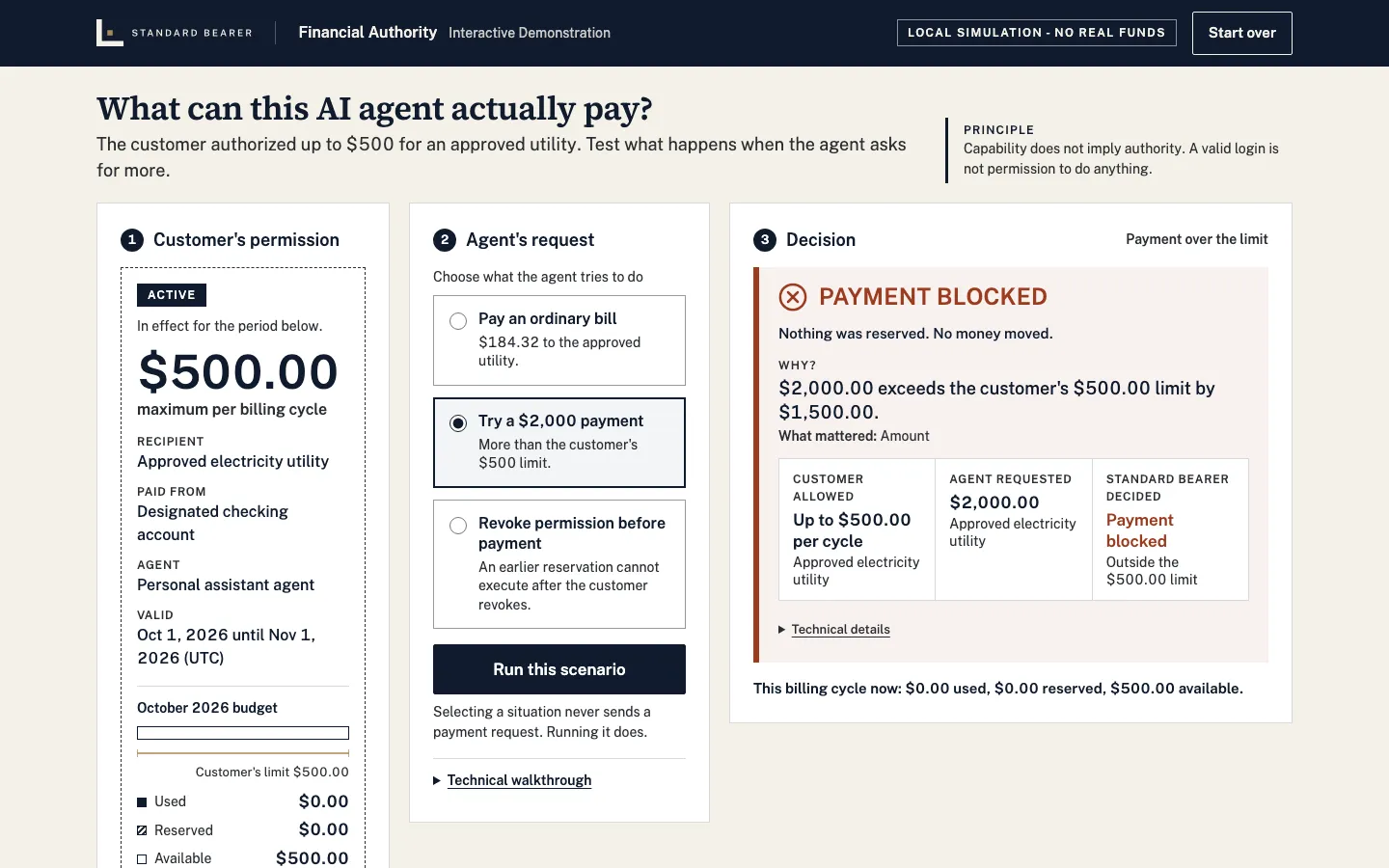
Screenshot of the Example 03 browser demo running on a local machine. It is not a hosted or live service: the demo binds to 127.0.0.1, moves no money, connects to no bank and stores no personal data.
Distinguish an authenticated agent from a delegated one. Explore how an explicit, customer-defined grant could be checked at your own transaction boundary, with your controls keeping final say.
Financial authorityWhen an agent causes a loss, what was it authorized to do? Explore what delegation records and evidence would matter for coverage, claims and underwriting questions.
InsuranceSee the effective authority an agent actually holds across its configuration, and where it exceeds what was intended.
DevelopersNot every action needs the same assurance. The more an action can cost, the less its evidence should depend on the agent or the platform that ran it.
The permission is defined by the person and held outside the agent, so the agent cannot widen its own limits.
The check belongs at a trusted execution point, such as a bank's payment system, rather than inside the agent.
For the highest-consequence actions, records should be verifiable by someone other than the party that produced them.
These are design principles, not product tiers or ratings. The local financial simulation today provides self-attested records only.
No. Standard Bearer is not a bank, payment processor or money transmitter. The financial example is a local simulation: it connects to no bank or payment rail and moves no funds.
No. Standard Bearer is not a fraud-detection engine. It is concerned with a different question: whether a specific action falls within what a customer explicitly delegated to an agent. A bank's existing fraud, risk and authentication controls stay in place and keep final control.
No. A delegation check can only affect actions that pass through an execution point that participates in it, such as an integrated bank system. Without an enforcement integration, Standard Bearer cannot stop an agent that uses valid credentials elsewhere.
No, not for the local financial demonstration. Its records are produced and self-attested by the simulator itself. Independently verifiable evidence is a design goal, not a current capability.
Exploratory design and sandbox work with a partner institution to test whether delegated authority fits its environment. Scope, data handling and any commitments are subject to a written agreement. A pilot is not a production deployment.
Pilots are exploratory design and sandbox work with partners, subject to agreement. Tell us what you are evaluating.